SURVIVORS & HEALING
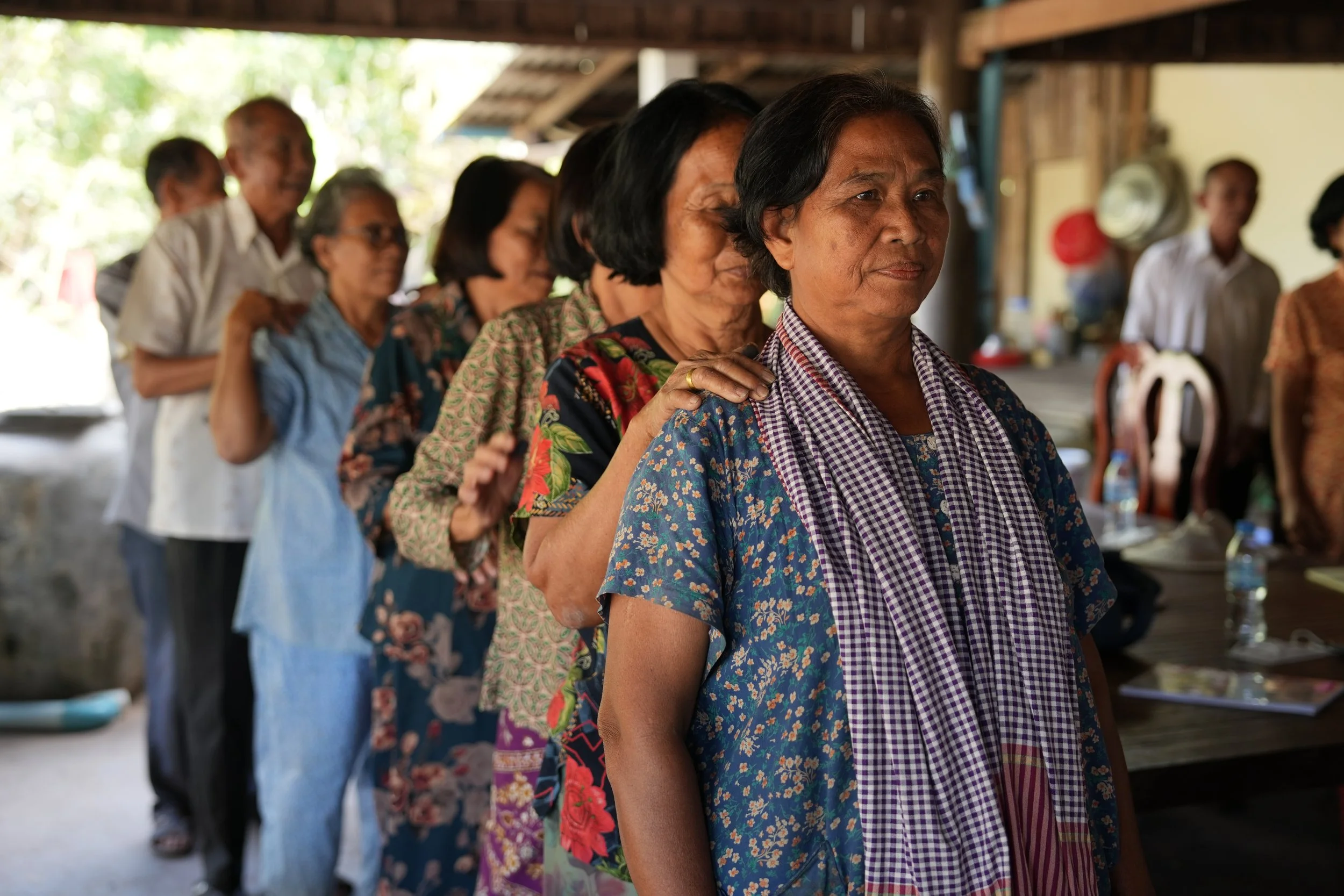
Most survivors in this area are now in their seventies and eighties — for them, support cannot wait. Our work here follows what survivors themselves ask for, and builds the local relationships that keep them visible long after a single project ends.
The projects below show how.
Restoring Dignity, Justice and Healing for Survivors of Conflict-Related Sexual Violence
Interim Reparative Measures Project | In partnership with TPO Cambodia and the Global Survivors Fund
During the Khmer Rouge regime, thousands of women and men were subjected to sexual violence — forced into marriages and coerced into relationships under direct regime control. For decades, most survivors remained invisible. Stigma and silence prevented them from speaking about what they had endured, and their experiences went largely unrecognized.
Today, many survivors are between 65 and 80 years old. They continue to live with the long-term physical, emotional, and economic consequences of the violence they experienced — and time is running out to provide them with the recognition and support they deserve.
Together with TPO Cambodia and the Global Survivors Fund, Kdei Karuna supports survivors through a project that combines individual reparations, psychosocial support, community memorialization, and survivor-led advocacy.
The project was built on careful groundwork. Before it began, Kdei Karuna carried out a preparatory phase of consultations and focus group discussions with survivor activists, partners, and local facilitators — Khmer, Cham, and ethnic Vietnamese alike — to shape the scope of the project around what survivors themselves identified as their needs. This research laid the foundation for the survivor-centered approach the project follows today, and is available in our Resources.
Recognition
For many survivors, this is the first time their experiences have been formally acknowledged.
Survivors are given space to share their stories, connect with others who share similar experiences, and participate in decisions that affect their lives. Being seen, heard, and valued — after decades of silence — is itself a form of healing.
Justice
Reparations mean far more than financial support.
Survivors use individual reparative measures to access healthcare, improve their living conditions, and invest in small livelihoods. But beyond the practical, reparations send a clear message: what happened was wrong, and survivors have a right to recognition and dignity. For many, this acknowledgment is long overdue.
Healing
Many survivors have spent decades carrying painful memories alone.
Through psychosocial support, peer networks, and Older People's Associations, survivors rebuild trust, strengthen social connections, and find community among people who understand their experiences. Members describe reduced isolation, renewed confidence, and a sense that they are no longer facing their challenges alone.
Building for the future
The project also works to strengthen the local structures that will support survivors beyond the life of the project — engaging local authorities, community leaders, and civil society to keep survivors' needs visible and to support survivor-led initiatives that last.
Healing and Reconciliation
ECCC reparations project (case 002/02)
Improving mental well-being for survivors of torture under the Khmer Rouge regime · Supported by USAID – finished
Over three years, Kdei Karuna and Transcultural Psychosocial Organization (TPO) Cambodia worked to improve the mental well-being of survivors of torture from the Khmer Rouge era. The project widened access to mental health support and used truth-telling and memorialization to address trauma at the individual, family, and community levels. Reaching 15 provinces across Cambodia, it brought survivors and young people together through training workshops, community dialogues, and Forum Theatre, and trained local facilitators in conflict resolution and basic mental-health support so that communities could sustain this work themselves.
Responsive Youth to Survivors of Torture
Young people supporting survivors through dialogue, art, and Forum Theatre · Supported by the United States Institute of Peace (USIP) – finished
Survivors of torture under the Khmer Rouge — including survivors of sexual violence — have often had no one to talk to about what they endured. In Kampot and Kampong Thom, Kdei Karuna trained 140 young people in family dialogue, oral history collection, and basic mental-health support, then brought them together with survivors through artwork, intergenerational dialogue, and Forum Theatre. Twenty-four survivors took part, and the young people documented seventeen of their life stories — becoming an attentive audience for experiences long kept private.
Community Support during the Covid-19 Pandemic
Reaching isolated survivors with mental health support when communities were cut off · Supported by the International Coalition of Sites of Conscience – finished
The pandemic isolated exactly those people who could least afford it. When travel and gatherings became impossible, Kdei Karuna trained fifteen Local Facilitators in basic mental-health support and mediation so that survivors would not be left alone in their own communities. Working across five provinces — Siem Reap, Oddar Meanchey, Kampong Chhnang, Kampong Thom, and Kratie — they reached seventy Khmer Rouge survivors, most of them elderly women, combining community-based support with online counselling.